 Amplibee

What is the PewTranslate Language Lookup?
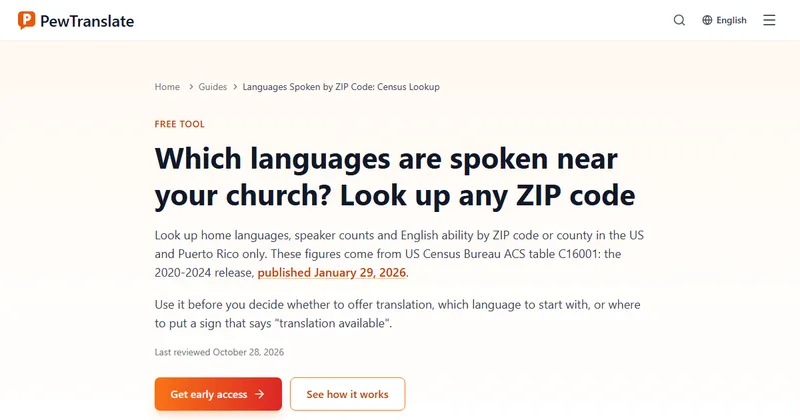
It is a free tool that shows languages spoken at home, speaker counts and English ability for a US ZIP code or county.
The site suggests using it before you decide whether to offer translation, which language to start with, or where to put a sign saying translation is available.
Where does the data come from?
It comes from the US Census Bureau American Community Survey, table C16001, for 2020 to 2024.
The table covers language spoken at home by people aged 5 and older. The release was published on January 29, 2026.
ZIP results use Census ZIP Code Tabulation Areas, which do not exist for every postal ZIP code.
How does the lookup work?
Enter a ZIP code, or choose a state and county, and your browser loads a public data file.
- ZIP codes load a file for the first three digits
- County lookups load a file for the selected state
- The site says your entry is not saved, and shared links include the ZIP code or county
What are the limits?
The figures are survey estimates for areas, not counts of people or of a particular congregation.
- It covers the 50 states, DC and Puerto Rico only
- Speaker counts show 90% margins of error, but percentages and English-ability totals do not
- Five-year estimates pool 2020 to 2024 responses, so they may miss recent changes
- Census language groups are broad, and “speak English less than very well” is a starting point, not a measure of translation demand
- The page does not update automatically
What does PewTranslate cost?
The lookup is free, and the live-translation product is not open yet.
The site lists translation at US$5 per hour per language, charged only while someone is listening, with US$20 of free credit for each new account when accounts open. You can join the early-access list from the site.
Alternatives to PewTranslate Language Lookup
To learn which languages a community speaks, you can query Census data directly, use a ready-made lookup, or ask local groups. This tool is a ready-made lookup on the same Census table.
- data.census.govThe Census Bureau’s own data site, where you can open table C16001 and build your own tables.data.census.gov ↗
- Local community groupsSchools, libraries, community centers and neighboring congregations often know which languages people actually use.
How PewTranslate Language Lookup compares
| Option | Best for | Trade-off |
|---|---|---|
| PewTranslate Language Lookup | Church staff and volunteers who want a quick ZIP or county view with margins of error and no account | Estimates for broad language groups and for areas, not for a specific congregation |
| data.census.gov | Analysts who want full control over geography and years | More steps to learn, and no plain-language reading of the results |
| Local community groups | Learning what a specific community needs | Takes time and is hard to compare across places |
The PewTranslate lookup may suit you if you want a fast first look at languages near you. Treat it as an estimate and confirm local needs with the people you serve. The translation service is not open yet, so check the site for its status.
Questions people ask about PewTranslate Language Lookup
What is the PewTranslate Language Lookup?
A free tool for finding languages spoken at home in a US ZIP code or county.
Is it free?
Yes. The lookup is free with no signup.
Where does the data come from?
The US Census Bureau American Community Survey, table C16001, 2020-2024 five-year estimates.
Does it cover every country?
No. It covers the 50 US states, DC and Puerto Rico only.
Does every ZIP code work?
Not always. ZIP results use Census ZIP Code Tabulation Areas, which do not exist for every postal ZIP code.
Are the numbers exact?
No. They are survey estimates. Speaker counts show 90% margins of error.
Does it tell me how many people need translation?
No. “Speak English less than very well” is a starting point for identifying need, not a measure of translation demand.
Is PewTranslate’s translation service available?
Not yet. It lists US$5 per hour per language and an early-access form.
What are the alternatives to this lookup?
You can query the same Census table yourself on data.census.gov, or ask local community organizations about the languages in your area.