 Amplibee
What is wordradar?
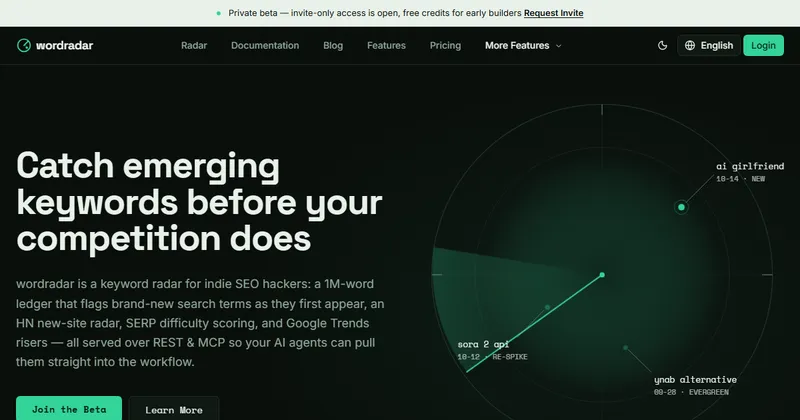
wordradar is a keyword radar. It flags search terms and websites as they first appear, so you can spot new topics early.
It is served as a REST API and as a native MCP server, so scripts and AI agents can pull the same data you see on the site.
What data does it provide?
The site lists six data surfaces behind one API key.
- Word ledger: first-seen dates and direction tags for a large word corpus
- New site radar: domains that show up on Hacker News
- Proxy-KD scoring: a 0 to 100 difficulty estimate from a top-10 SERP
- Trends risers: rising queries with breakout flags
- Domain timeline: registration and web archive history for a domain
- MCP server: the same tools for agents such as Claude and Cursor
What does it cost?
Public boards and the keyword-pulse endpoint are free. Other queries use metered credits bought as one-time packs: 19 USD for 2,000 credits, 49 USD for 6,500 and 99 USD for 15,000.
The site says credits never expire and that one niche deep-dive costs roughly 20 to 40 credits. Beta access is by invite, with free credits for early builders.
What are the limits?
The product is in beta. Its signals come from its own corpus and heuristics, and the maker states they do not guarantee rankings, traffic or revenue.
Alternatives to wordradar
Established keyword tools cover large keyword databases and backlink data. wordradar is narrower: it focuses on newly appearing terms and sites, and is built to be called by scripts and agents.
- AhrefsA large SEO toolset with keyword, backlink and site data.ahrefs.com ↗
- SemrushAn SEO and marketing suite with keyword research.semrush.com ↗
- Google TrendsGoogle’s free tool for how search interest changes over time.trends.google.com ↗
How wordradar compares
| Option | Best for | Trade-off |
|---|---|---|
| wordradar | Finding newly emerging keywords and feeding them into scripts or AI agents | It is in beta, with a smaller and different dataset than the large SEO suites |
| Ahrefs | Full SEO research and site audits | It is a broader and costlier product |
| Semrush | Teams that want keyword, competitor and advertising data in one place | Subscription pricing and a larger tool to learn |
| Google Trends | Checking whether interest in a topic is rising | It does not give first-seen dates, difficulty scores or an agent-ready API |
wordradar is a fit when you want an early signal on new keywords and sites, delivered to code or an agent. For full keyword volumes and backlink data, a larger SEO suite covers more.
Questions people ask about wordradar
What is wordradar?
A keyword discovery and SERP research service available through REST and native MCP, aimed at indie builders and agents.
Is it free?
Public boards and the keyword-pulse endpoint are free. Other queries use paid credits, and beta access is by invite.
How much do credits cost?
Packs are 19 USD for 2,000 credits, 49 USD for 6,500 and 99 USD for 15,000. They are one-time purchases that do not expire.
Does it have an MCP server?
Yes. A native MCP endpoint offers the same tools as the REST API.
Where does the keyword data come from?
From its own keyword corpus and capture pipelines. First-seen dates are within that corpus, not a claim about the whole web.
Will it tell me what will rank?
No. The maker says the signals do not guarantee rankings, traffic or revenue.
Is it production ready?
It is in beta, so expect changes.
What are the alternatives to wordradar?
Ahrefs, Semrush and Google Trends are common keyword research tools. They differ in data coverage, price and API access.