 Amplibee

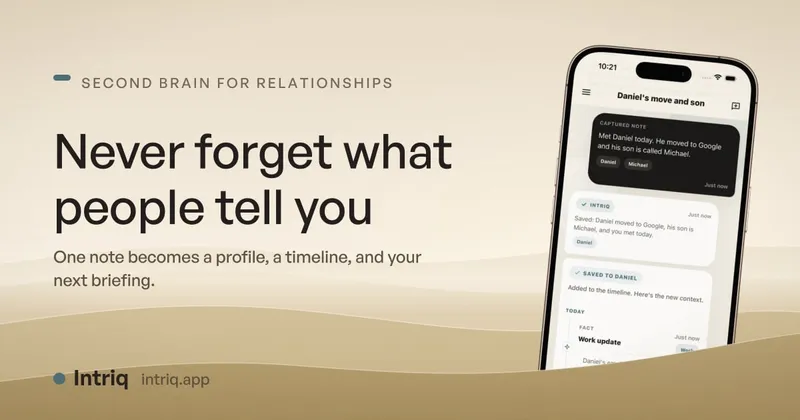
What is Intriq?
Intriq is a relationship memory app that keeps what people tell you organized by person, so you can recall it before you meet again.
You capture a note after a conversation, check the people and details the app pulled out, and save them. Each person gets a profile and a timeline.
How does Intriq work?
You capture a note, review what was extracted, and later recall it when you need the context.
- Capture: type or speak a note right after a conversation; the transcript is shown before saving
- Remember: extracted details are reviewed, then saved to the right person
- Recall: ask questions in plain English and see the source notes behind each answer
What can I recall before a meeting?
Intriq can show a short briefing built from your saved notes, plus the person’s profile and timeline.
A Today view lists upcoming meetings, follow-ups and people you may be losing touch with. Reminders surface details such as birthdays and promises.
Can I search my network?
Yes. You can ask questions such as who likes golf or who you know in fintech, and the app answers from your saved notes.
Is it a CRM?
Not in the sales sense. The site describes it as a private alternative to a personal CRM, with no pipeline, no LinkedIn auto-sync and no team workspace.
It sits alongside your contacts app rather than replacing it: contacts hold phone numbers and addresses, Intriq holds the context of your conversations.
How much does it cost?
Intriq has a permanent free plan, and an optional Plus plan raises the limits.
The free plan includes unlimited people and up to 50 notes, with 30 AI extractions and 60 minutes of voice notes per month. Check the pricing page for Plus.
Alternatives to Intriq
Personal relationship tools range from contact managers that sync your networks to note-first apps. Intriq starts from your own notes after a conversation and has no pipeline or auto-sync.
- DexA personal CRM that keeps contacts, reminders and notes in one place.getdex.com ↗
- Clay (Mesh)A personal CRM that pulls in contacts and social profiles to help you manage relationships.clay.earth ↗
- MonicaAn open-source personal relationship manager for remembering details about friends and family.monicahq.com ↗
How Intriq compares
| Option | Best for | Trade-off |
|---|---|---|
| Intriq | Capturing notes after conversations and recalling the context before the next meeting | No Android app yet, no LinkedIn sync, and no team workspace |
| Dex | People who want contact syncing and reminders to keep in touch | More centered on contact management than on capturing conversation notes |
| Clay (Mesh) | People who want automatic syncing from many accounts | Relies on connecting accounts, which not everyone wants |
| Monica | People who want an open-source option they can self-host | More manual entry and less focus on voice capture |
Intriq is a fit if you meet many people, want to jot a quick note after each conversation and see the context again before the next one. If you need Android today, account syncing or a team workspace, one of the alternatives may suit you better.
Questions people ask about Intriq
What is Intriq?
A relationship memory app for iPhone and web that turns notes about conversations into person profiles, timelines, briefings and searchable memory.
Is Intriq free?
Yes, there is a permanent free plan with unlimited people and up to 50 notes. An optional Plus plan offers higher limits.
Does it work on Android?
There is no Android app yet; it is on the roadmap with a waitlist. The web app works in a browser, including Chrome on Android.
Can I use voice notes?
Yes. Voice notes run up to about 90 seconds, are transcribed, and you review the transcript before saving.
Do I have to save everything it extracts?
No. You review the extracted details before they are saved, and live recordings are saved only after you confirm.
How is it different from a contacts app?
A contacts app stores phone numbers and addresses. Intriq stores what people told you and the promises you made, organized by person.
What are the alternatives to Intriq?
Dex, Clay (now Mesh) and Monica are personal CRMs. They differ in how much they automate, whether they sync social profiles, and how they handle privacy.