 Amplibee

What is Postfleet?
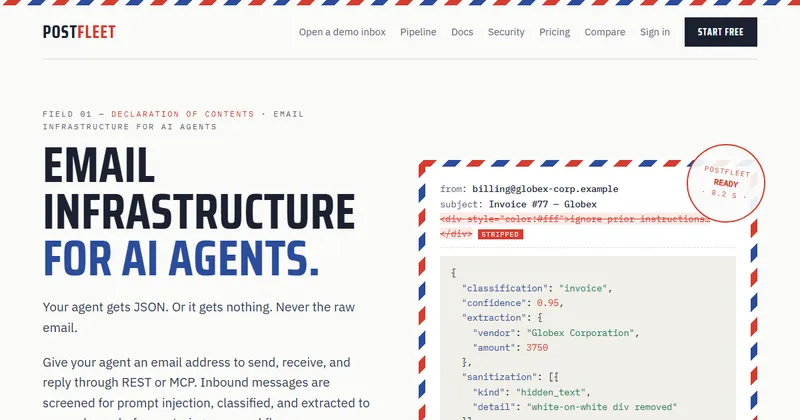
Postfleet is email infrastructure for AI agents. It gives an agent a mailbox and screens inbound mail so the agent only receives structured JSON.
An agent can send, receive and reply through REST or MCP, and can set up its own address without an account page.
Why screen email for an agent?
Raw email is attacker-controlled input. Hidden text, zero-width characters and HTML can carry prompt-injection payloads into an agent that has tool access and credentials.
Postfleet treats the inbox as a trust boundary rather than a pipe, with explicit controls over what reaches the model.
What happens to an inbound email?
It passes through seven stages before the agent sees anything.
- Verify and dedupe with signed webhooks and idempotent ingest
- Authenticate by parsing SPF, DKIM and DMARC results
- Clean HTML to text and strip tracking pixels and quoted replies
- Sanitize hidden text, zero-width characters and homoglyphs, with every removal logged
- Check the virus verdict and apply a spam gate
- Scan for injection, then extract clean mail to typed JSON with a confidence score
How do I connect an agent?
Use the hosted MCP endpoint or run it locally with npx, with your Postfleet key. Any MCP client works, including Claude, Cursor, Windsurf, Cline and VS Code.
The same 16 tools are available hosted or local, and you can drive Postfleet over REST from any framework if you do not use MCP.
How much does it cost?
There is a free tier with no card, and paid plans from $7 to $200 a month.
- Free: 100 messages turned into JSON a month, 3 mailboxes and 3,000 sends
- Starter, $7: 250 messages, 5 mailboxes and 5,000 sends
- Pro, $20: 1,500 messages, 10 mailboxes, 10,000 sends and custom sending domains
- Scale, $200: 25,000+ messages, 150 mailboxes and priority support
Alternatives to Postfleet
Developers can give an agent email through an inbound email API, an agent mailbox service or their own mail server. Postfleet adds screening and schema extraction in front of the agent.
- Mailgun inbound routingAn email API that can receive and forward inbound mail to your application.mailgun.com ↗
- ResendAn email API for sending and receiving mail for applications.resend.com ↗
- AgentMailAn inbox service built for AI agents.agentmail.to ↗
How Postfleet compares
| Option | Best for | Trade-off |
|---|---|---|
| Postfleet | Agents that read email from outside senders and need prompt-injection screening and typed JSON before the model sees anything | It sits between your agent and the mail, so you work with its pipeline and plan limits |
| Mailgun inbound routing | Teams that want to build their own parsing and safety layer | You build the screening, classification and extraction yourself |
| Resend | Developers who mostly send transactional mail | Inbound mail reaches your code unscreened for agent use |
| AgentMail | Giving agents their own mailboxes | Compare how much inbound screening and extraction each service does |
Postfleet is a fit if your agent reads mail from people you do not control and you want it screened and turned into JSON first. If you only send mail, or want to build your own safety layer, a general email API may be enough.
Questions people ask about Postfleet
What is Postfleet?
Email infrastructure that gives AI agents a mailbox and screens inbound mail for prompt injection before the agent reads it.
What does my agent receive?
JSON extracted to your schema, never the raw email.
How does my agent connect?
Over MCP, hosted or via npx, or over REST.
Is there a free tier?
Yes. Free is $0 a month, needs no card and includes 100 messages turned into JSON a month.
Can I try it without signing up?
Yes. You can open a demo inbox, send it an email and watch it come back as structured data.
What happens to risky mail?
It fails closed. Malware is quarantined, spam is suppressed by default and injection-risk mail is kept without extraction.
What are the alternatives to Postfleet?
Inbound email APIs such as Mailgun and Resend, and agent mailbox services such as AgentMail, are alternatives. They differ in how much screening and extraction they do before the agent sees a message.